2014年12月14日 星期日

Newly published 
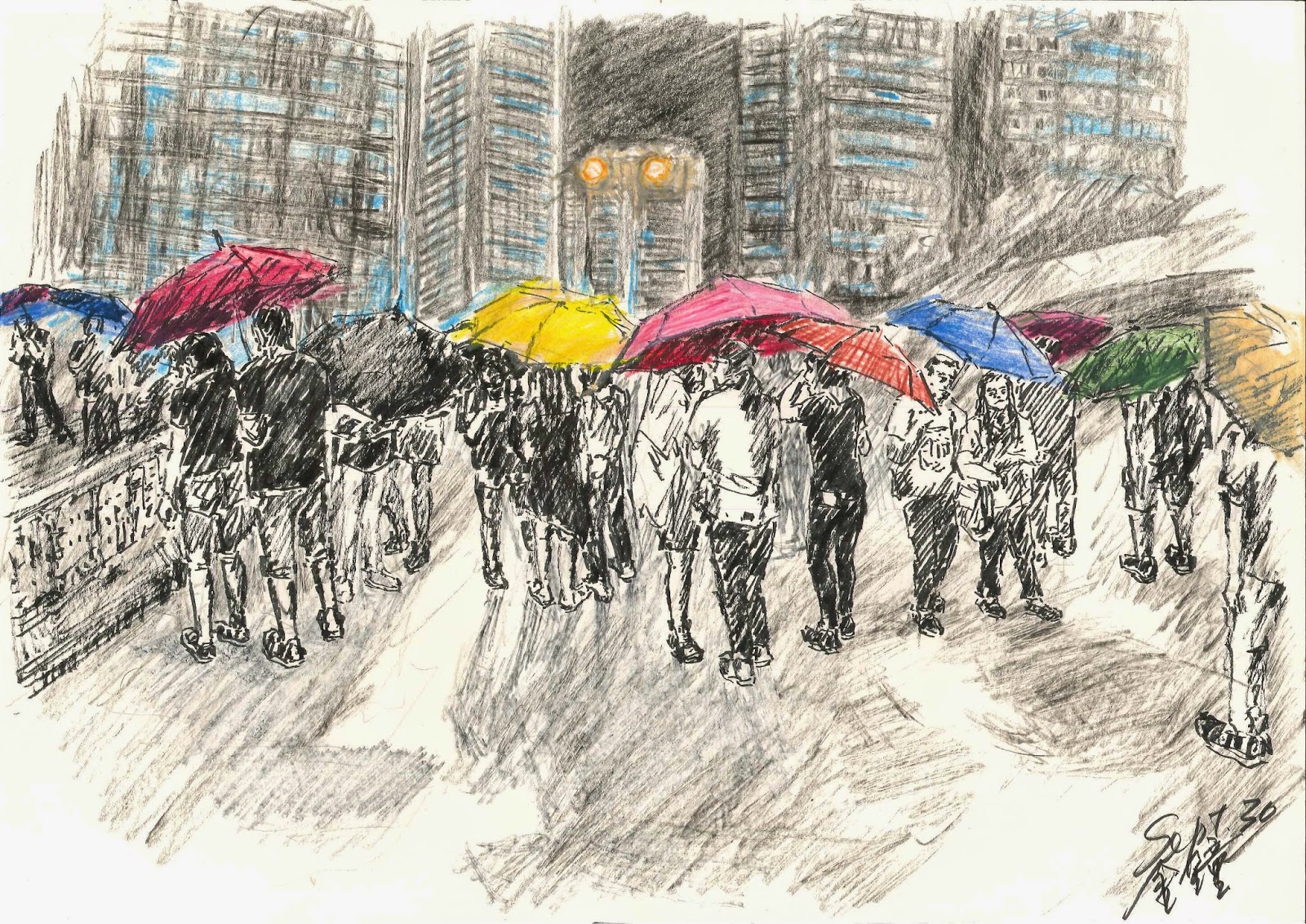
UMBRELLA SKETCHES

A first hand impression of the HK Umbrella Movement 2014


Introduction: A Collection of Raw Images
I was visited by an overseas couple on October 28, exactly one month after the day of tear gas, a Hong Kong scene that shocked the world. The man was my university friend. I accompanied them to the occupied zone in Admiralty. After that, I showed them my sketch book to let them have some idea about what had happened before their arrival. I didn't know how they felt at that time – it was just a few hours after their 16-hour long flight from New York. But I have to say, flipping through the pages of my sketch book, I myself felt the rawness of the images.
Up to that time, I had already had nearly one hundred sketches of the Occupy movement, about 70 in that sketch book. I started them on September 27, a day before the tear gas struck. On that day, I was invited (better said enlisted) by a group of cartoonists, the Comic Daemons, to make cartoons or sketches of people in a shopping district. Their intention was to arouse public awareness, through a day of street art, about the anticipated action of occupying Central, Hong Kong's central business district, to protest the government's deceitful political reform plan. The unannounced target day of the action was October 1, the National Day of the People's Republic of China (PRC), because, as known by all, Hong Kong's political reform was in fact hampered by the PRC regime.
I am not a cartoonist, but I took part in the Comic Daemons' exhibitions in support of their effort to promote democratic reforms in Hong Kong. I do brush-and-ink painting and woodcuts. Joining their cartoon exhibitions, I could only make some cartoon-like pieces for show. On the day of street art, I was enlisted to do a two-hour session together with other cartoonists, but I did hardly more than one and half. Unlike the others there, I was relatively slow, completing about a dozen sketches in my own session. All of them were given away on the spot, except two. One of them happened to be the sketch of the cartoonist Zunzi and a common friend of ours. In its raw state, the sketch was no more than a few pencil lines. I gave it a retouch with felt-tipped marker later in my studio.

It was the September 27 drawing session on the street that gave me the idea to make sketches for what would happen later on. In that evening, I brought along my sketch book to a rally outside the Government Headquarters in Admiralty. However, I found it was too dark and too crowded for me to work there with my sketch book. And, I must admit, the atmosphere was too tense. So, I only took a few photos that night.
On the next day, I went to the rally in Admiralty again. It was bright enough during daytime, but I could jot just a few pencil lines on several sheets and left everything unfinished. Later, when I was out on Harcourt Road among thousands of protesters, I found most of them were preparing for the possible actions of the police. I was too nervous to take my sketch book out again from my backpack. Soon, the first round of tear gas came. Then came the second and the third round. That night, after several rounds of tear gas, I went back to my studio at midnight to work from the photos. I had a sleepless night, working until noon the next day.
Things went better for me after the day of tear gas. I could visit the occupied zones and do sketches at ease. To save time, I tried to draw on the spot very brief outlines of what caught my attention with a pencil and took a photo for detail. The unfinished part was left to be done later. Within a week, I found my old sketch book, some 120 sheets, two thirds blank before the day of tear gas, almost completely full. I also found I had failed to catch up with what I saw even though I worked non-stop days and nights. I had so little sleep that I was totally exhausted. Thereafter, I resorted to record what I saw with my camera and do sketches at a slower pace.
This book is a collection of nearly all the sketches I did in a period of less than two months, from September 27 to the moment the police were about to clear the occupied zone in Mongkok. They are all raw images of what I had seen before and on the day of tear gas, and later on, in the three occupied zones in Admiralty (outside the Government Headquarters), Causeway Bay (Hennessy Road) and Mongkok (Nathan Road).
I have thought of turning some sketches into brush-and-ink paintings or woodcuts, but some friends encouraged me to put the raw images together to make a book. Knowing that financial support for this book project was essential, some of them even agreed to order in advance and in bulk. My heartfelt thanks to them.
I have also thought of doing a more complete book of sketches covering later dates, but friends strongly believed that I should not wait: “Do it now! And a supplement later.”
By the time I compiled this book, the Occupy movement was still on-going. When I was drafting this introduction, the police were trying, badly, to take control of Mongkok, clearing roads by charging crowds and making forceful arrests.
Of the 139 sketches printed in this volume, about half were done in an A4-size (21 cm x 29 cm) sketch book, the other half on A3-size (30 cm x 42 cm) water-colour paper. The media used were pencil and felt marker (sign pen). Colour was added later with colour pencil - and also crayon when I ran out of yellow (the iconic colour of the HK Umbrella Movement/Revolution).
Having worked as a journalist, I decided that I should make a narrative by telling the five Ws: what, when, where, how and why. Therefore, the sketches are dated by the day the scene was captured, with its location specified. The short captions, I hope, can be strung together and read as a sequential story.
So, here they are, the raw images of what I have seen over the past two months. I would like to dedicate this collection to the new generation of Hongkongers who are fighting for their future.
Fong So
November 28, 2014


2014年1月31日 星期五

馬年祝願  Lunar New Year Greetings 
各位:
馬年伊始,一卡賀歲。
此圖所喻,是我自己。祝願你們都比我好!
Hi Friends,
Just an e-card for the Lunar New Year - the Year of the Horse.
Please don't get me wrong. The image of this card is about me, not you.
Yes, I have worked reasonably hard over the year. The result/return is just so so, but I don't mind.
Things are always like that. I just try my best and hope that fate will be in my favour.
As for you all, I hope that you are doing much better.
Wishing you a prosperous year ahead!

2013年12月31日 星期二

Mad Proses - Some More 雜詩六首補誌

雜詩六首補誌


        月前因見港事蹇非,一時怒氣難紓,憤而寫詩,曾載於網誌(見10月28日貼文《忽然作詩?》)。際此2013與2014 交接,畧為點算,原來過去一年還另外拼湊了若干,茲抄錄如下,以作備忘。

解車公靈籤 (2013年2月)
        農曆新春,新界鄉事大老按例到沙田車公廟為港求籤。數年前,曾得下籤,籤文有「眼前鬼卒皆為妖」之句,證諸港事,論者多以為靈驗。孰料此回所得的車公靈籤,竟然也同樣掃興,籤文四句,曰:「駟馬高車出遠途,今朝赤腳返回廬。莫非不第人還井,亦似經營乏本歸。」車公此籤,又再成為話題。議論聲中,我亦步籤文原韻,以四句為靈籤作解,於互聯網上與友人分享。
       鬼妖喧囂據版圖,仰息西環畫葫蘆。但奉河蟹河犯井,卻恨人心不回歸。
       按:鬼妖、西環、河蟹、河犯井等詞語,各有出處或由來。

中秋夜有感 (配圖)
        因見明月當空,想到來年此時港人將會面對的局面。
        苒苒幾盈虛,澄澄變今古。來年清光照,對抗攔路虎。
        按:首二句借用王昌齡五言古詩。

大學聘任起紛爭
        10月,香港大學宣佈新校長人選。來者並非華裔,聘自海外,此事在港大校內及校外俱引起紛爭。友輩論及其事,多認為不應排外。再看排外的言論,乃知難忍「排內」才是該等人士的心結。
        煌煌國子監,祭酒聘外人。黌宮烽煙起,排內始其因。

黑手 (11月,配圖)
       日前有打手文章刊於「喉舌」報章,宣稱香港的泛民議士為「賤骨頭」,須予打壓,且打得再狠也不見得天會塌下來。於是寫此四句,並取自己畫作局部,改成配圖。
        干預今已成常例,難容更多硬骨頭。咆哮咒天天未塌,黑手從此不須收。

路姆西之歌 (12月)
         香港三任特首俱屬欽點。現任者CY梁,備受民眾抗議,港人多稱之為「思歪」或「狼」。日前有抗議者別具心思,不是擲鞋,而是以布製狼型玩偶擲向梁某。布狼為瑞典宜家公司產品,名為Lufsig,卻有中譯叫「路姆西」。此內地譯名之粵音與粗口相諧,而「擲」又可作「掟」或「丟」,「丟」與「屌」諧音。路姆西經此公然一擲,即時成為反梁神獸,在港被搶購一空,布狼事件亦成為國際新聞。因此事與特府宣佈高度虛假的政改諮詢時間相近,乃綜合其事,濃縮成廿字,只供粵音誦讀。
        特府昏無日,政改道路迷。豺狼犯眾怒,掟佢路姆西。
        按:末句「掟」字作「丟」亦可。

習之傳承 (配圖)
        毛澤東1976年去世,雖然鄧小平在毛後曾作某程度的「非毛化」,但毛的幽靈至今仍在神州大地繞盪。毛生於12 月底。習近平上場之後,國內對毛的官方取態如何,於毛誕可見。
        毛鄧三傳習登峰,穩定唯效老祖宗。如今且做中國夢,經尚近平政近東。
        按:習之前曾大事宣講他的「中國夢」。

2013年10月30日 星期三

Website Revamped 網頁更新


Newsletter (Oct 30, 2013) /通訊 (2013年10月30日)

Website Revamped
We have been urged to revamp the website of Fong & Yeung Studio for quite a long time and we started to do it several months ago. Now that the work has been more than half complete. And we decided to launch it as early as possible to replace the old one.
        The revamped website is an online art gallery. You can see our exhibitions and view the images of all the artworks. You can also place orders for our publications and contact us for price-list. We sincerely hope that all visitors of this website will find it more informative and user-friendly.
       Yes, it's revamped, but not fully completed yet. Modification will continue.
       Please visit us at: www.fong-yeung.com
       Your valuable comments and suggestions will be most appreciated. Please contact us.
網頁更新
        很多朋友早已認為我們要更新楊方創作室的網頁。我們這次全面更新,前後用了好幾個月,現在大體上完成了基本框架和過半數的內容。為了讓新網頁盡早與訪覽者見面,我們決定現在就上載,取代舊有的版本。
        我們盡力將新網頁設計成網上藝廊。在這個網上藝廊,你可以看到我們的展覽,看到所有作品的圖像;你可以訂購我們的出版物,也可以聯絡我們查詢作品價目。我們希望新網頁對訪覽者能提供更多資訊和便利。
        誠然,網頁已經更新,但仍須增加內容及作出改進。
        請點擊閱覽:www.fong-yeung.com
        我們期待你的寶貴意見和建議,請聯絡我們。

2013年10月28日 星期一

忽然作詩?(Poetry, or Mad Proses?)


        從文字轉到圖像之後,已甚少為文,更沒想過寫詩。其實一向只是閑時偶爾讀點詩詞,讀舊體較多,但於聲韻格律卻所知幾近於零。近來因港事蹇非,怒氣難紓,不期然想到魯迅一首舊詩的其中一句:「怒向刀叢覓小詩」,於是拉雜拼湊了若干,現抄錄上載,至於是否符合格律或可有「打油」「抽水」的成份,讓各位看官評說算了。

其一、10月20日即事
        10月中,香港特府宣佈增發電視牌照,三選其二,廣泛認為應獲發牌的香港電視落選,全城嘩然,咸指決策違反事理,並斥特首連同其行政會議黑箱作業,相信背後必有政治因素。20日,逾十萬民眾上街抗議,支持香港電視員工進駐政府總部之廣場爭取公義。出於義憤,往政總撐場,及歸,憤而有作。
        牛豬轉替萬事非,復有豺狼只賣乖。虎狼在前魑魅後,遂教萬人再上街。
        按:(1)1997,牛年,董[建華]上場。(2)2007,豬年,曾[蔭權於2005接替董,之後]連任。(3)狼,港人已有認識。(4)十萬上街,包圍政總,去年就有反國教事件[反對要在學青少年接受洗腦的所謂「國民教育」],如今又有電視牌照風波。因特府倒行逆施,此種場面肯定會愈來愈多。

其二、讀網友面書來料有解
        10月23日,瀏覽互聯網資訊,見Facebook網友傳來資料,乃知特府頭目放言,聲稱三選二非因政治,只是「順得哥情失嫂意」云云。聞此謅言,也謅編了四句。
        約規民意視若虛,傳媒電視豈等閑?非關哥情或嫂意,實緣北雪已南潛。
        按:社會輿論多認為特府的發牌決定有違政經常規,如此漠視民情亦屬悖理,故事由應是北雪南來。
其三、諷喻弊制三十三倀
        10月25日,立法會泛民主派議員支持以特權法案促使特府公開電視發牌准則,得票27。在畸型結構的立會內,建制派議員佔多數,有33票保駕,維護黑箱決策,反對泛民的動議。因見港運趨黑,再製黑詩一首。
        保皇保黨保黑箱,白黑是非已昭然。港運趨黑連國運,仰息黑朝只認權。
        按:所謂「建制派」,城中亦稱之為「保皇黨」。

        圖像:附載圖像原為木刻版畫Yea and Nay右半之局部。按友人所示,將之重複再重複,湊成33之數。
        (2013年10月28日)

2013年8月2日 星期五

漫畫刁民 The Comic Daemons

「漫畫刁民」是一個新近成立的組合,成員是一群本地的漫畫家/藝術家。

近日,各方都在談論「普選」、「佔領中環」等社會議題。面對重大社會議題,我們這批「漫畫刁民」因緣際會,決定今年八月在港九兩個場地舉行一個以普選為主題的漫畫展覽,名為「漫人迷普選」。

展場:(1) PubArt Gallery (港島中環贊善里7B地下); (2)活化廳(九龍油麻地上海街404號地下)

「漫畫刁民」現時有成員廿餘人,包括一木、白水、江記、李香蘭、阿平、馬龍、張萬有、智海、莉莉、黄照達、尊子、鍾偉強、Cuson、方蘇、Hark Yeung、Martin Lau、Vvn Ho、 黃國才、 黃志輝、Him Lo、Kit Man@社漫、小花@社漫、Tman@社漫....... 這次展覽會展出他們多種形式的作品。展覽同時歡迎公眾參與相關的活動及講座。(展期:2013年8月6–31日)

開幕酒會:
日期:2013年8月8日(星期四)
時間:下午 5時30分 ﹣ 8時30分
場地: PubArt Gallery (中環贊善里7B地下)
聯絡及查詢:請電郵comicdaemons@gmail.com,或透過面書專頁 www.facebook.com/ComicDaemons 與 Cathy Lee 小姐 聯絡。

The Comic Daemons is a group newly formed by a number of local comic writers/artists with a view of drawing people's attention to the developments of a major social issue in Hong Kong – namely, the movement of Occupying Central. The group has decided to stage an exhibition entitled “Universal Suffrage Now” at two venues on both sides of the harbour in August, 2013. This is first time more than 20 cartoonists/artists group together to work on a social issue. The two venues are:
 (1) PubArt Gallery (Ground Floor, 7B Chancery Lane, Central, Hong Kong);
 (2) Woofer Ten (Ground Floor, 404 Shanghai Street, Kowloon)

Members of the group include: APink, Brian Chan, Cheung Man Yau, Choi Hoi, Cuson, Emu, Flora@HKSocComic, Fong So, Hark Yeung, Him Lo, Justin Wong, Kacey Wong, Kit Man@HKSocComi, Kong Kee, Lily Lau, Malone, Martin Lau, Rainbow Leung, Richard Chung, Tman@HKSocComic, Vvn Ho, Wong Chi Fai, Zunzi....Their artworks in different forms will be showcased. The exhibition will be on from 6 August to 31 August.

Opening of the exhibition:
Date: 8 August 2013
Time: 5.30 – 8.30pm
Venue: PubArt Gallery (Ground Floor, 7B Chancery Lane, Central, Hong Kong)
Enquiries: Please contact Ms Cathy Lee at comicdaemons@gmail.com or www.facebook.com/ComicDaemons.

2012年12月23日 星期日

Festive Greetings

Festive Greetings  賀節迎年
I have been sending e-cards as festive greetings for some years, using the images from my artworks. Before preparing the e-card this year, I had several images ready. I must confess, most of them are “festively incorrect”. So finally I decided to go further away from “normal expectation” by selecting the most defiant and rebellious one - “The Shoe-throwers”.
Ponding how the image would be perceived, I added the following lines, in Chinese and English, to the e-card:-

Pardon me if I am being “festively incorrect”
for sending greetings with such an image.
But I really want to see the defiant shoe-throwers
of all countries aim their shoes
at the oppressive regimes.

在賀節迎年的時候發送這種圖像,
抱歉於節慶未免有欠正確。
不過,世上偏有某等民賊和暴虐政權仍在肆虐,
我們應樂見舉鞋奮起的人讓他們領受教訓。

The e-card was sent out a few days ago. It was almost immediately uploaded to Facebook by a friend who was among the first to receive my greetings. He did it half a day before I myself. As expected, over the past two days, I have received quite a number of friendly comments and remarks by emails and from the social networking site.
The e-card is posted here. What do you think about it? All comments welcome. Thanks.

(FYI, I have thought about using another image “The Three Men of Virtue”, instead of “The Shoe-throwers”. It's also posted here.)

2012年7月31日 星期二

My Facebook Timeline


My Facebook Timeline
面書的時線

Over the past month, to coincide with two huge protest marches in Hong Kong, I have posted quite a number of images, with captions, onto the Timeline of my Facebook webpage. Some of the images are selected and uploaded here for those who might have missed what I have posted on FB.
短短一個月內,香港就有兩次大規模的抗議遊行。這段時日,我上載到「面書」的網頁上的一些圖像和文字,可視作兩次行動的印記。

七一 今年的七一遊行,規模幾乎可與2003年的七一相比。July 1 The day's event reminded me of the protest march on 1 July 2003.

22/6/2012
「七月的烈燄」: 2003年7月1日是一個很不尋常的日子。那一天,我們創造了歷史。超過五十萬人,頂着酷暑,上街示威。(「七一系列」之一。從今天起,陸續上載。)
The Flames of July: On 1 July 2003, a remarkable day, Hong Kong people made history: in scorching heat, more than half a million people took to the streets. (This is the first piece of the 'July 1' series. More will be posted here.)

23/6/2012
一家四口: 那年的七一,在烈日下,是數之不盡的黑衣服和紅臉孔。
A Family Event: It was a protest of all in black. People marching in black created a new visual icon for Hong Kong.

24/6/2012
韶顏: 那時候,一場奪命疫症剛剛結束,但來勢汹汹的第23條草案仍陰霾密佈......
Glowing Faces: ...We went through a deadly epidemic, but were still haunted by the Article 23 related bill which posed a threat to freedom of expression.

25/6/2012
!!! - 畫面是一群年輕人,畫題是三個感嘆號。有一提議是,可題為「人在幹,天在看」。
!!! - A group of young protesters. Seeing that the piece of work was only given three exclaimation marks, a friend suggested that it should be entitled "Heaven's watching what we're doing".

26/6/2012
一致行動: 人們憤怒了,推輪椅也要上街。與其說那是「傷健同行」,不如說是「傷疲盡起」。今年,人們只是更加憤怒了。
A United Effort: People were angry then. Even those wheelchair-bound joined in. After nine years, people are angrier now.

27/6/2012
並肩: 幾代人走出來,表達他們的憤懣。那時候的小孩,現在已成長了,今年在遊行中會與他們再次並肩。
Side by Side: People young and old showed up to voice their anger and disappoinment. The then young kids have grown up now. You will march again side by side with them this year.

28/6/2012
「為什麼?」- 遊行進行中,警察起了某種作用。可是這些年來,警方大大小小的動作明顯是愈來愈多了。人們都會問:"這是為什麼?"
"Why?" - During all protest marches, the police play a role. It's obvious that they have been getting more and more restless over these years. Why?

29/6/2012
活劇: 那年的大遊行之後,撐了兩年,撐出了這個景象。(明天上載的圖片,會給我們很多七一要上街的理由,一個比一個強烈。)
Melodrama: The mass protest in 2003 made a difference. That's what happened after two years. (The images uploaded tomorrow will give us many reasons to take to the streets on July 1, one stronger than the other.)

30/6/2012
傀儡: 第一個是全不濟事,第二個是做盡糗事,跟着的一個只帶來一片昏黑。因此,七一上街是迫出來的。
The Stooges: The first one gained notoriety for failing to do everything, the second one for doing all the nasty things, and the third one for bringing only darkness. So, let's take to the streets on July 1.

1/7/2012
上街! - 令人憤慨的事太多了!今天應該做的就是上街!
Right On! - So much has happened so far! Today, let's come out to show that we are raged!

日前有朋友寫了點回應,說是看到了圖像箇中「悲苦的一面」。由此,我記起曾引述過一段文字:「世上如果還有真要活下去的人們,就先該敢說,敢笑,敢怒,敢罵,敢打,在這可詛咒的地方,擊退了可詛咒的時代!」(魯迅‧忽然想到)
A comment to the images I posted says: "Sad in a way..." That reminds me of the words I have quoted before: "If there are still men in the world who really want to live on, they must first dare to speak, laugh, rage at, revile, fight, and defeat this accursed age in this accursed place!" ("Sudden Notion" by Lu Xun, translated by Yang Xianyi and Gladys Yang)(I would to like say 'thank you' to all the friends who liked the series over the past week.)

反對洗腦教育
Joint action against 'National Education', the brainwashing school curriculum


22/7/2012
我們需要這樣的「國民教育」嗎?......讓思想衝破牢籠!

28/7/2012
2007年「《特區十年》系列」的兩件作品。左邊的一張題為「他們會看得見嗎?」畫中左上角形似飛鳥的二字是普選,但普選卻一再被否決了。老人家望穿秋水,年幼的一代又怎樣呢?右邊的一張題為「給他們更好的明天」,他們是明天的一代。然而,在2012年的特區十五年之際,傀儡特府硬推給他們的卻是要他們洗腦的所謂「國民教育」。

30/7/2012
曾經不此一次畫過扶老攜幼上街遊行的景象,現今的情況是連坐嬰兒車的幼童也成了遊行者。對此,我們應有甚麼感悟?!

2011年10月20日 星期四

It all started with ... (My catalogue notes)


It all started with ... (My Catalogue Notes)

Fong So


*The text uploaded here is extracted from an origninal text of about 5,500 words published in September 2011 in a catalogue to accompany the exhibition entitled The Centenary of China's 1911 Revolution: Paintings and woodcut prints by Fong So.


It is generally agreed that modern China began with the 1911 Revolution (the Xinhai Revolution). A large number of books, scholarly works and general reading materials about the Revolution are available. Nearly all of them start with the story of Sun Yat-sen, the most influential revolutionary of the time.
The life story of a man can be told in many ways. Sun Yat-sen himself told his own life story many times during his life time. In 1923, two years before his death, while giving a speech at the University of Hong Kong, he began his life story with his school years in Hong Kong. Some twenty-seven years before that, in 1896, when he was still a young revolutionary in exile, he told his life story in his first autobiography beginning with what he called the 'late age'.
I didn't think that much about the beginning and the end, when I embarked on this paintings and woodcuts project. From the start I believed there would be some way to present the artworks when they were finished. Then the order given to the series of artworks would tell the beginning through to the end. The project started early last year, with the first piece of artwork appearing in June 2010 and the last piece being finished as late as July 2011. When I started to produce this catalogue, I came to the conclusion that the easiest and most natural way to arrange the whole series was to follow a chronological order. Therefore, my Xinhai project exhibition starts with the 'late age' of Sun Yat-sen and his contemporaries.
In 1896, when Sun Yat-sen was a fugitive sojourning in England., he was introduced to a Cambridge sinologist, Professor H.A. Giles, by Dr James Cantlie, his teacher at the School of Medicine in Hong Kong. At that time Sun had just became a celebrated anti-Qing revolutionary after being kidnapped by Qing officials at the China Legation in London and then freed. He was invited by Professor Giles to write an autobiography to be included in his work A Chinese Biographical Dictionary. He obliged by writing Giles a letter, in which he wrote that he was “born in a late age”. For me, the best way to visualize Sun's 'late age'‚ is to produce an image of what people and life looked like at that time. To do this, I drew inspiration from an old Hong Kong picture of the late Qing Dynasty (1644-1911), which records the scene of a crowd watching an open-air theatre production. Hong Kong at that time, ceded in 1842 after the First Opium War, was a colony under British rule. I first saw the picture in an old album published in 1970 by the then City Museum and Art Gallery of Hong Kong. In my composition, I cut out the background, focusing on the heads of the crowd and people's facial expressions. The background is replaced by an excerpt from Sun's letter to Giles. It is more than an excerpt: it follows the calligraphy of Sun's letter. Before working on this piece, I had tried to avoid putting inscriptions into my paintings, though it is a common practice for nearly all painters using the Chinese media of brush and ink. I modified their practice by using diluted or 'watered down' ink to copy Sun's calligraphy. That way, it is in 'Sun-style' and I am just a 'copycat'. The portrait of the young Sun Yat-sen is next to those words composed by him (Plate no. 1).
......
Very little visual material is left from the 1911 Wuchang uprising. We know that it was the rising in revolt of the Qing New Army soldiers that fired the first shot of the revolution. Old pictures now available are mostly those poorly-equipped New Army soldiers. We also know that an 18-star red flag, symbolizing the unification of China's 18 provinces at that time, was used by the insurrection army. As the Hubei Viceroy's Yamen, the Qing government's headquarters in the province, was destroyed by artillery fire in the uprising; the newly-founded Hubei Military Government turned the building that housed the provincial assembly into its headquarters. Here, in my attempt to visualize the 1911 Revolution, I have combined the insurrection soldiers, the 18-star red flag and the insurgents' headquarters, known among the locals as the Red Mansion, with Sun Yat-sen's remarks about this uprising (No. 12). According to Sun, the success in Wuchang came as an 'accident'.......
Sun Yat-sen was on a tour in the United States of America when the Wuchang uprising broke out. While stopping over at Denver, Colorado, he read in a newspaper that the move in Wuchang turned out to be a success. He continued his tour to New York, then Britain and France, before returning to China. Shortly after his arrival, he was elected the Provisional President of the Republic by the provincial delegates. On 1 January 1912, he went to Nanking to assume the post and inaugurate Year One of the newly founded Republic of China. The oath he took, a piece of his calligraphy, can be found reproduced in various publications. In the portrait I did of Sun, I have his oath copied next to him (No. 14).
......
The Provisional Governemnt in Nanking (Nanjing) operated for just three months, from 1 January to 31 March 1912. After the abdication of the young Manchu Emperor Xuantong, an official ceremony was held in Nanking in which Sun Yat-sen, the Provisional President, led the officials of his Provisional Government to the Ming Mausoleum to pay homage to the founder of the Ming Dynasty (1368-1644), the dynasty before the Qing. My composition of the Provisional Government is based on the old pictures left from that special occasion. In this composition (No. 16), Sun is in the middle of the front row; at his side is Huang Xing, the Minister of the Army. Some other ministers of Sun's cabinet are there, but there is no need to name them one by one. The three big characters carved on the gate of the Ming tomb, as well as the titles of the Provisional Government's gazette and the Provisional Constitution, form the backdrop. Also in display is the five-colour national flag used by the newly-founded Republic. The flag continued to be in use until 1928.
......
Revisiting Hong Kong, Sun Yat-sen gave a speech at the University of Hong Kong on 20 February1923. He told his audience that Hong Kong was his intellectual birth-place and the place where he got his revolutionary and modern ideas. A good pictorial record of the occasion is a photograph taken outside the Great Hall (now Loke Yew Hall) after Sun's speech. This is the photograph on which my largest-ever woodcut is based (No. 21). In this particular piece, I focused on the section in the middle; only those around Sun were included (my apologies to those cropped out). I added only one thing not seen in the photograph: the clock tower above the Great Hall.
......
According to my parents, they had to recite the testament of the Founding Father of the Country (Sun Yat-sen) at school during their school years. That was some seventy years ago. The testament is copied in my work “The Last Wishes” (No. 23), but not in full. It is in 'Wang-style' calligraphy, as the testament was drawn up by Wang Jingwei at Sun's dictation or composed by Wang with Sun's approval. Wang was then a high-ranking Kuomintang leader among Sun's entourage and was one of the very few non-family members who were allowed to be there by Sun's sickbed.
......
The next piece “The Prolonged Enmity” (No. 26) is a pictorial summary of a long history. Featuring Chiang Kai-shek and Mao Zedong, I summarized the hostilities between the Kuomintang (KMT) and the Chinese Communist Party (CCP) in a single piece. On the left side, Mao is shown in three stages: first as a 'red bandit' in his Jiangxi period (the early 1930s); then as the communist leader winning the civil war (1946-49); and lastly as the great leader of the CCP and the country until his death (1949-76). On the right side, Chiang is also shown in three stages: first at Sun Yat-sen's side commanding the KMT army; then as the 'Generalissimo' of the country during the war against Japanese invasion (1937-45); and lastly as head of the KMT government ruling Taiwan (1949-1975).
......
Two woodcuts are made to wrap up this centenary series: “Waiting” (No. 34) and “The Arab Spring” (No. 35). As things and events related to these two pieces are so fresh, there is no need to explain everything in detail.All inscriptions are of remarkable origins. I hope they can stimulate thought and contemplation. After working on these pieces, I became fond of Solveig's Song and jasmine.
There are some short stories I should like to recount before ending my catalogue notes
Over the past year, while I have been working on this project, a question has been frequently put to me. The question is: “How did the project come about?” The answer is: “It all started with a casual chat some time early last year (2010) among friends, most of them old acquaintances going back to my university years.” Over tea or wine, one of them exclaimed: “Now that it's the year 2010, the next will be 2011. A hundred years have gone by and things are still like this!” There was no need for further explanation; we all knew what he meant to say. The casual talk then turned into a preliminary exchange of ideas about my plan to produce a painting and woodcut series to mark the centenary of the Xinhai Revolution. Some of the friends joining the casual talk later became the members of my Xinhai task group.
The conclusion of our casual talk on that day was a straightfoward one, as offered by one of the participants citing the words of Sun Yat-sen: “The revolution has not been successfully concluded yet; comrades should strive on!” I later carved a seal based on this well-known saying by Sun, but leaving out the words “revolution” and “comrades”. The seal print now appears in some of the brush-and-ink paintings in this centenary series.
Another short story is my fond memory of my old mentor when I was a small boy living in Gaungzhou. His name is He Xia. I met him by chance at the age of ten, while I was making a sketch of a painting in an art gallery. He was then a retired old man of about seventy. He introduced me to the art of the Lingnan masters, in particular that of the founder of the School, Gao Jianfu. He later introduced me to another Lingnan master, Professor Chao Shao-ang, who would became my painting teacher when I moved to Hong Kong. Professor Chao had been the student of Gao Jianfu's younger brother Gao Qifeng, another famous Lingnan master. I know very little about my old mentor He Xia, except that he had been a soldier working at the side of Sun Yat-sen when he was young. He did not paint; he practiced calligraphy. He showed me his collection of calligraphy and paintings. I remember that a piece of calligraphy hanging in his study was penned by Sun Yat-sen. Some time last year, while digging out some old stuff in my studio, I found by chance that I still kept a letter written to me by my old mentor some 45 years ago. It was years after I moved to Hong Kong that I came to know the extraordinary life story of Gao Jianfu (1879-1951). He happened to be a member of the Revolutionary Alliance when he stayed in Japan in 1906. In the 1911 Canton (Guangzhou) uprising in April, he was one of the team leaders of the enlisted revolutionary fighters. He took refuge in Hong Kong after that failed attempt and continued to be an activist. After the Xinhai Revolution, he became a modern master promoting the 'New Chinese Painting Movement' and founded the Lingnan School. I very much share his guiding principle of 'New Chinese Painting': “brush and ink should follow [the development of] time.”
(Contents of the exhibition catalogue include: colour plates of all 35 artworks; chronology; an essay by Louie Kin-sheun; biographical sketches of over 50 historical figures; Fong So's catalogue notes and selected bibliogrphy.)

一切都始於...... (作畫札記)


一切都始於...... (作畫札記)

方蘇


*原文刊載於2011年9月配合題為《辛亥百年現代路:方蘇繪畫及木刻版畫》的展覽而出版的畫冊,此處上載於網誌的版本為部份段落的摘錄。

現代中國應以1911年辛亥革命為起點,這是大家都會同意的說法。論述辛亥革命的書籍很多,學術著作、普及讀物,多不勝數,絕大多數會從孫中山的生平說起。
一個人的生平,可以有種種方式去講述。孫中山在世時,就曾一再講述自己的生平。1923年,他去世前兩年,曾重訪香港,並應邀到香港大學去作演講,那趟他就講自己的故事,故事開始是他曾在香港受教育,而香港對他產生了很重要的影響。在那趟演講之前二十七年,他也述說過自己至那時為止的生平,當時他是個流亡海外的革命志士,年僅三十,第一次應邀寫自己的自傳,他就從自己所生的世代說起。
我在動手繪製這個水墨和木刻版畫系列時,沒有想過這個系列的起始和終結。我只是一件又一件地製作,起始和終結的問題,我一開首就認為最後自然會有答案:到展示時總要有先後,那排列順序就會定出起始和終結了。我這項目從去年(2010)初開始,第一件作品在去年中出現,最後一件則遲至2011年7月才完成。最後到編製這本目錄時,我認為最簡單而又最自然的順序,莫過於把畫作按史事的年月先後排列,因此這個系列也就從孫中山所說的「晚世」開始。
時維1896年,孫逸仙人在英國倫敦,身份是亡命者,因為他經由香港西醫書院教師康德黎的介紹,認識了劍橋大學一位漢學家,漢名為翟理斯。那時孫在倫敦蒙難之事剛剛結束,他剛從滿清駐英公使館的禁閉中走出來,成了令人刮目相看的革命家。翟理斯教授邀約孫寫一自傳,編入其著作《中國人名辭典》(又名《古今姓氏族譜》)之中。他函覆翟理斯教授,信件內容就是他自己的傳記,一開始就說自己是「生於晚世」。對我來說,要描繪孫所說的「晚世」,最好就是能以圖像顯現當時的黎民百姓的生活面相。我的圖像構思源於一張清末的香港舊照,照片攝錄了香港一處露天劇場看戲的人群。那時香港處於英治之下,割讓香港是1842年,在第一次鴉片戰爭之後。我第一次見到這張照片,收錄在一本1970年出版的圖冊裏,出版者是當時的香港博物美術館,圖冊名為《百年前的香港》,按此推算,也就是距今一百四十年前的香港。我處理原圖的辦法是大幅剪裁,背景統統去掉,只截用人頭,重新組合,結果是一大堆頭像,面容各異,表情複雜,擠滿了畫面。此圖背景改用文字,錄寫了孫逸仙的函件其中小部份。在此之前,鑑於大多數使用水墨為媒材的畫人都在畫上題款,以證書畫同源,我卻認為可以另闢蹊徑,書畫分家,於是盡可能不在畫作上題字。這趟既要採用文字,我想也應有點不同,因此我改用淡墨,翻尋手蹟印本,臨摹「孫體」,我只是依樣畫葫蘆,不是寫書法。畫面所見,「孫體」字的盡頭,就是孫年輕時的畫像 (圖版編號1) 。
......
辛亥武昌起義留下來的視像材料甚少,有之就是起義成事後的若干圖片,多數是裝備簡陋、衣衫粗劣的士兵。為人所共知的一個事實,就是打響革命第一槍的是屯駐武昌的新軍士兵,而新軍是清廷設置的軍隊,因此是新軍士兵起來造反。義軍使用的旗幟,是紅地的十八星旗,十八星代表全國十八行省聯合。當時清政府的湖北總督衙門毀於炮火,革命後成立的湖北軍政府把新建的省議會大樓用作總部。我描繪武昌起義的木刻,把義軍士兵、十八星旗和軍政府總部 (當地人稱之為紅樓)併合在一起,再加上孫中山後來對武昌首義的評述,作為注腳(編號12)。據孫所說,武昌的成功,是「成於意外」。
......
武昌首義之際,孫中山仍在美國奔走募款,他得知起義成功,是在科羅拉多州的典華市 (後譯丹佛)看報紙時見到的。他繼續行程,轉赴紐約,再越洋造訪英、法,然後才乘船返國,先到香港,再北上上海。他抵埗不久,即被各省代表選為行將建立的共和政府的臨時總統。1912年1月1日,他到南京宣誓就職,宣佈成立中華民國。他的誓詞手蹟早已廣為流傳,印在各種書刊內。畫作所見,我在他的畫像一側,臨摹了他的誓詞手蹟(編號14)。
......
設都南京的臨時政府,為時僅三個月,由1912年1月1日至3月31 日。清帝宣統2月遜位,民國臨時總統孫文曾率臨時政府官員到南京明孝陵祭告明太祖。那次祭告活動留下了一些照片,我就用來打稿,繪畫臨時政府。畫面所見,臨時總統孫文居中,身旁是他任命為陸軍總長的黃興,其他內閣總長不必逐一細數。背後門樓上刻着「明孝陵」三個大字;臨時政府的公告和宣佈的臨時約法,也以大標題顯現;還有民國最早通過使用的五色旗也是背景一部份(編號16),五色旗一直到1928年仍是民國國旗。
......
1923年,孫中山在重訪香港時,曾應邀在2 月20日到香港大學去作演講。他對出席的聽眾說,他從前在香港讀書,教育是來自本港,並直言其革命思想係從香港得來。他那次演講有很好的照片留存,就是演講後在大禮堂 (今陸佑堂) 外的集體照 。我至今為止最大的一件木刻,就用這張照片為底本。因為場景較大,我的畫面只截取了正中央那三分之一,僅有照片中較近孫中山的那些師生才能收入畫面 (未能收入的諸君子,只好在此向他們致歉) 。我的木刻只加了一件照片上沒見到的實物:大禮堂上的鐘樓(編號21) 。
......
聽父母那代人說,他們小時候上學讀書,背誦《國父遺囑》是例行公事。這份遺囑,現在臨摹在畫作上(編號23,遺願)。因畫面空間及構圖的考慮,並未抄錄全文。1924年底孫中山到北京,汪精衛跟隨北上。最後孫臥病,除家人以外,准許隨侍病榻的人為數甚少,汪是其一。孫的遺囑由汪寫成或筆錄,由孫簽名,再經多人列名證明。因遺囑由汪精衛執筆,故此畫面上臨摹的也就是「汪體」。
......
「對峙」(編號26) 是以一串圖像去概括一段相當長的歷史,繪畫的內容是國共或蔣毛兩造長期敵對的狀況。畫面一分為二,一邊紅,一邊藍。左邊紅色再分三截,呈現毛澤東三段時期:由下而上,先是毛被稱為「赤匪」的江西時期 (上世紀三十年代初) ,之後是中共在內戰 (1946-49)取勝之前,再之後是毛由建政到去世那廿多年。右邊藍色也分三截,呈現蔣介石三段時期:由下而上,先是孫中山在世時蔣隨侍其側(1925之前),之後是抗日戰爭(1937-45)勝利在望時的委員長,再之後是退守台灣後的國府首領(1949-1975)。
......
最後,要用兩張木刻版畫作這個百年系列的終結:「等待」(編號34) 和「阿拉伯之春」(編號35) 。因為兩者都是很近期的事,所以不必細作解說。兩圖的文字都有來歷,留待觀眾仔細咀嚼。完成了這兩件作品之後,我很喜歡《蘇薇姬之歌》和茉莉花。
結束這篇作畫札記之前,還可以講點小故事。
第一則故事,我用來回答開始這個系列之後經常被問及的問題:「你這計劃是怎麼搞出來的?」答案是:「就從一次閑談開始。」那是去年(2010)初,幾個老友碰頭,多數早在大學時經已認識。茶酒之間,有人感嘆:「轉眼已是2010年,來年就是2011年。一百年了,還是這種樣子!」無須解釋,大家都知道他說什麼,那趟閑談就變成了啟動這個百年項目的前奏,並且開始就我提出的打算製作一個水墨和木刻系列交換意見,尋找資源。之後,好幾個參與閑談的朋友就成了這個自發的辛亥項目的成員。
那趟初步討論的結語很簡單,就是孫中山留下來的名句:「革命尚未成功,同志仍須努力」。後來我繪製這個系列時,刻了兩個印章,其一就錄下了孫中山此一名句,不過我的印章去掉了「革命」和「同志」這四個字。這兩個印章,我用來做水墨畫作的壓角印鑑。
另一則小故事,聯繫到我對少小時候一位師長的感情。他名叫何俠,人如其名,確有俠者之風。那時我住在廣州,認識他時,我才十歲,而他已是七十開外。我們初見的地方是廣州一處展覽廳,我正在看畫描稿,引來他的注意。他後來引導我認識一些畫人的作品,主要是開創嶺南畫派的先輩高劍父的作品。再之後,我移居香港時,他寫信引介我去見嶺南大師趙少昂教授,我因此得以成為趙教授門下弟子之一。趙教授早年學畫於高奇峰,高奇峰是高劍父的弟弟。我跟隨何俠時,因尚年少,對他所知不多,只知道他曾是軍人,早年在孫中山身邊做過事。何師並不繪畫,只寫點書法。他給我看收藏的字畫,讓我臨摹。他家裏有一小幅題字,是孫中山書贈,掛在書室內。我去年翻找舊物,竟然找到他寫給我的一封信,那是老人家四十五年前的手蹟了 (插圖6)。
離穗來港多年之後,我才知道高劍父 (1879-1951) 絕不尋常的生平。原來他1906年在日本學畫時加入了同盟會。1911年廣州的反清起義,他是一隊志士的領軍隊長,失敗後曾避居香港。辛亥之後,他成為現代中國畫大師,提倡「新國畫運動」,創立嶺南畫派。關於「新國畫運動」,他有句格言,我極有同感:「筆墨當隨時代」。
(此一畫冊的內容包括:整個系列35件作品的彩圖;年表及作品編目;雷競璇撰寫的專文;五十多個歷史人物的小專;方蘇的繪畫札記及參考書目。)

2011年8月29日 星期一

Exhibition in Three Universities

Newsletter - August 29, 2011


Dear Friends,


The Centenary of China's 1911 Revolution:
Paintings and woodcut prints by Fong So


The year 2011 marks the centenary of China's 1911 Revolution (the Xinhai Revolution).

You are cordially invited to the openings of the debut exhibition of Fong So's new series of brush-and-ink paintings and woodcut prints, entitled The Centenary of China's 1911 Revolution, to be hosted by three universities in Hong Kong.


Modern China began with the 1911 Revolution. Over the past 100 years, Dr Sun Yat-sen, his followers and many political leaders have endeavoured to create epoch-making changes in modern China, but their goals have not been achieved up to now. Fong So's new series is an artist's attempt to explore, through a series of artworks, what China has been through over the past century and what the future holds for Chinese people. Special emphasis is given to the unique role played by Hong Kong during this period.


Please take note of the exhibition venues, exhibition time and join us in the opening ceremonies. Please also extend our invitation to other friends. Your support will be most appreciated.


●The Main Library, The University of Hong Kong
5 September - 15 October 2011
(in support of the HKU Centenary Celebrations)
Opening: Noon (at 12), 5 September 2011 (Monday)


●Lobby Gallery, Chung Chi College Administrative Building,
The Chinese University of Hong Kong
6-30 September 2011
(as one of the 60th Anniversary Celebratory Events of the College)
Opening: 4:30 pm, 6 September 2011 (Tuesday)


●The Center for the Arts, Hong Kong University of Science and Technology
5-18 September 2011
(as one of the 20th Anniversary Celebratory Events of the University)
Opening: 1 pm , 7 September 2011 (Wednesday)


Members of the Task Group:
Chow Yung-ping, Hung Ching-tin, Mau Chi-wang,
John Chan Cho-hung, Fong So


*Please see location maps and public transports to the three exhibition venues.
**To make arrangements for public viewing, please contact the venue providers. It is free admission at CUHK and UST. As the exhibition venue at HKU is inside the library building, pre-arrangement is requried.


Enquiries:
Xinhai Task Group:
Mau Chi-wang (96441260) ;mailto:mauchiwang06@gmail.com
Fong & Yeung Studio: Fong So (92202202) ;mailto:fong@fong-yeung.com
HKU: Ms Brenda Lau; mailto:bhwl@hku.hk
Chung Chi College, CUHK: Ms Ruby Ko; mailto:rubyko@eservices.cuhk.edu.hk
HKUST: The Center for the Arts, HKUST, Ms Mok (2358 6149); mailto:artsctr@ust.hk


Maps and Public Transports:
HKU:
(www.hku.hk/maps/pop_maps.html?section=mc&checklight=u_drive), bus 23, 40 or green mini bus 10, 11, 31 from Admiralty.


Chung Chi College, CUHK: (www.cuhk.edu.hk/chinese/campus/cuhk-campus-map.html), MTR East Line to the University Station.


HKUST: (https://sao.ust.hk/aesthetics/images/art_hall_location/index.htm), bus 91, 91M from Choi Hung MTR Station, or 91M and the green mini bus 11,11M, 11S from Hang Hau MTR Station.


-----


各位老友:


辛亥百年現代路──方蘇水墨及木刻版畫

2011年是辛亥革命一百週年。我們以一個畫展作為紀念,展出方蘇新繪製的水墨及木刻版畫系列,名為「辛亥百年現代路」,其重點是中國現代化之路和香港的特殊角色。

辛亥革命是現代中國的開端。百多年來,孫中山先生等志士仁人致力開創歷史,但他們的心願至今尚未真正實現。際此辛亥革命百周年,我們呈獻這個繪畫及木刻系列,旨在探討百年歷程的波折,放眼過去、現在和將來。


這個百年系列的首展,將於今年9月在本港三大學府舉行,三校為香港大學、香港中文大學崇基學院及香港科技大學,展場、展期及開幕禮的安排如下:


●香港大學 圖書館大樓
2011年9月5日至10月15日 (同賀香港大學百周年)
開幕禮:2011年9月5日中午12時正


●香港中文大學 崇基學院 行政樓大堂展覽廳
2011年9月6至30日 (崇基學院六十周年校慶節目)
開幕禮:2011年9月6日下午4時30分


●香港科技大學 藝術中心
2011年9月5 至18日(香港科技大學二十周年校慶節目)
開幕禮:2011年9月7日下午1時正


謹此電郵邀約,懇請蒞臨指導及支持,並請轉發我們的邀約給各方友好。


工作小組成員:周勇平、洪清田、繆熾宏、
陳祖雄、方蘇


*三校展場所在及最便捷的公共交通工具見附圖及說明。
**查詢公眾觀賞時間,請與三校聯絡。中大與科大基本上是自由進場;由於港大展場設在圖書館大樓內,参觀者煩請預先通知。


聯絡人:
工作小組:繆熾宏/96441260/mauchiwang06@gmail.com

楊方創作室:方蘇 /92202202/fong@fong-yeung.com

香港大學:劉小姐 bhwl@hku.hk
香港中文大學崇基學院:高小姐 rubyko@eservices.cuhk.edu.hk
香港科技大學:香港科技大學藝術中心 /莫小姐/2358 6149/artsctr@ust.hk


地圖及公共交通:
香港大學
(www.hku.hk/maps/pop_maps.html?section=mc&checklight=u_drive) 由金鐘往港大,可乘坐 23, 40號巴士或10, 11, 31號綠色小巴


中文大學崇基學院 (www.cuhk.edu.hk/chinese/campus/cuhk-campus-map.html) 可乘坐香港鐵路東鐵線,於大學站下車步行前往崇基學院行政樓


香港科技大學 (https://sao.ust.hk/aesthetics/images/art_hall_location/index.htm) 可乘坐彩虹地鐵站之 91, 91M巴士, 或坑口地鐵站之91M巴士及11,11M, 11S 綠色小巴

2011年1月5日 星期三


更能消幾番風雨──讀辛詞,思華叔


朋友在互聯網上設了一個紀念華叔的專頁(http://thankyouunclewah.wordpress.com/),傳來網址,要我寫點東西。我雖然曾經從事文字工作,但近年基本上是繪畫為多,甚少撰文。我作畫偏重人物,年前曾畫了一個肖像系列,其中最早讓我造像的就是華叔。如今睹像思人,想想還能寫些什麼。其實,關於華叔,我要說的,給他繪的畫像已經說了,重點在於畫像的取材或場景(見附圖)。
繪畫這幅華叔肖像,時間是2008年年初,而且可說是應一位朋友的要求而畫。事緣那年春節之前,那位朋友問我:「你畫人物,可有想過畫一幅司徒華的肖像?」我說:「華叔是個值得敬重的人物,很值得畫。他每年年宵期間都在維園寫揮春,就畫他寫揮春如何?」朋友說:「最好。」於是我到維園的支聯會攤位找華叔,略道來意,拍了幾張照片,新春期間的功課就是畫華叔寫揮春。畫成之後,交功課時,朋友說,他正在收集一些關於華叔並且有特殊意義的物品,結果他成了這張畫像的藏家。又因為在維園見華叔時,蒙他贈我八個字作為揮春,我覺得應該禮尚往來,其後就以一張他的肖像的水墨預習本回饋。
之後,這幅畫像曾兩次展出。第一次是群展,時間是2009年春節前後,我出畫兩張,其一是這張肖像。第二次是個展,展出我名為「我家我城」的人史系列,時間是2009年11月。「我家我城」這個系列展出前,我請參與造像的朋友每人寫點隨想,就寫三幾百字的小段或短文,出畫冊時可隨畫刊登。華叔是最早「交稿」的人,他寫來的一段文字是:「方蘇與我,相識於一九七三年的文憑教師薪酬事件。那時,他是中大學生會的幹事,來作訪問。至今,已整整三十五年有多了。他給我畫此畫時說:他不輕易為人畫肖像。這幅寫照,神態畢肖,我尤其喜歡那笑容和特定的場景──我在維園年宵市場的支聯會攤位寫揮春。他贈我稿本,謹向他致以衷心的感謝!」這段文字裏面就提到畫像的場景。
其他幾位應邀給畫冊撰文的朋友,都提到這幅華叔畫像,而早年曾擔任同人刊物主編的陳韜文(其後深造新聞及傳播,任香港中文大學新聞與傳播學院教授),寫來的文章就特別提到畫像的取材:「方蘇畫華叔時取材的是他為支聯會年宵攤檔寫揮春籌款的景象。華叔握筆含笑,一副從容的姿態,跟他平常接受傳媒訪問或者在台上叫口號的嚴肅樣子很不一樣。跟華叔連在一塊的社會抗爭事件很難一時計算清楚。不過,方蘇已經在華叔人像的背景添上爭取民主的揮春,華叔的今生大概已盡在其中。」
雖然,對這幅畫像的取材和場景,其他人已經提及,連華叔本人也都說過,但我仍覺得有幾句可以補充。
華叔每年在維園寫揮春,給支聯會籌款,是八九年六四之後開始的。只要有空,每年他寫揮春時我都會去看一看。有一年,提到寫聯語時,他對我說,有副集句聯,他很喜歡,上句辛稼軒:「更能消幾番風雨」,下句姜白石:「最可惜一片江山」。從他提及兩位南宋詞人辛棄疾和姜夔的名句,我感受到他那種憂國傷時的心懷。之後,每有風雨如磐的景況,我就不期然會想起這副集句聯,想到有同感的人那種心懷。也正因此,朋友要我畫華叔,我第一時間就會想到以維園寫揮春為場景。
華叔曾一再說喜讀辛詞,而辛棄疾因所處的時代及本身的經歷,下筆率多撫時感事之作,故此我讀辛詞,也稍能感受到華叔的心境。華叔其中一本最後出版的文章結集,書名用了辛詞「水龍吟‧登建康賞心亭」其中四字:「欄杆拍遍」。這個書名,也使我想到,他就是要通過辛詞的裂竹之聲,發出他那憂愁風雨的感嘆。

2010年2月18日 星期四

RARELY TOGETHER


Like many Hongkongers, I have a family with members living in different cities on different continents. My big sister, from a different mother, lives in Edmonton, Canada. Her younger brother, my other brother or half brother, lives in Guangzhou, China. My elder and younger brothers, no.3 and no.5 of the family, live in San Francisco, USA. I stay in Hong Kong.
The family members had never had the chance to gather together after my elder brother and I moved from Guangzhou to Hong Kong in 1962. Even now, although my elder and younger brothers are in the US, I am seldom together with them. The last time I visited them was 2007.
For some special reasons, I did a woodcut of my elder and younger brothers and I myself early this year, before the Lunar New Year. When I finished the woodcut, I decided to entitle it 'Rarely Together'.

By order of birth, I am the no.4 child of my father and no.2 of my mother. My father met my mother in the 1940s during the war against the Japanese invasion. At that time, my father already had a wife and two children, a girl and a boy, in his home village. After the war, my father and mother settled down in Canton (Guangzhou). Mom gave birth to three boys. I am the second one, and hence the fourth child of the family. In the mid-1950s, my mother and my big sister left Guangzhou for Hong Kong to earn a living for the family. My elder brother (no.3 of the family and Mom's first son) and I joined them in 1962. My father, my other mother and two brothers (no.2 and no.5) remained in Guangzhou.
My big sister, some 15 years senior to me, married a car mechanic. She emigrated to Canada with her family in the mid-1970s.
My other brother, the no.2 child of the family, was already an adult when I was young. His mother, my other mother, moved from my father's home village to Guangzhou after my mom left for Hong Kong. For some years, the three little boys of the family were looked after by her, with the help of my other brother. He stayed with his parents all the time in Guangzhou until they passed away in 1998 and 2008.
My elder brother, the no.3 child of the family, was a surprisingly naughty boy but a born leader. He proved he had a particularly good sense of music in his primary school and was appointed the conductor of the school chorus. I always believe, given the opportunity to develop his talent, he would be a good musician, perhaps a great conductor. However, after moving to Hong Kong in 1962, he left school the next year to work as an apprentice in a mechanic shop. Like other apprentices, he had to board at the shop. The shop was located on the other side of the harbour and there was no cross harbour tunnel linking Hong Kong Island and Kowloon at that time. For several years, I visited him twice every mouth. Then, when he finished his apprenticeship, I went to the university and lived away from home most of the time. We saw each other even less often. My elder brother eventually became a car mechanic, first in Hong Kong and then in San Francisco, after marrying a Burmese Chinese. He emigrated to the US in the late 1970s. Mom joined him in 1987.
My younger brother was a cheerful and carefree boy when he was young. He stayed in Guangzhou when my elder brother and I moved to Hong Kong. He lived on the mainland through the turbulent years of the Cultural Revolution. For years, he was excluded from the government's job allocation scheme. Instead, he was mobilized to leave the city and relocate to the remote rural villages. But he remained in Guangzhou. When Mom settled down in San Francisco, the first thing she did was to file a petition for him to join her in the US. Eventually permit was granted for him to leave China in 1990. On his way to the US from Guangzhou, he stopped over in Hong Kong and stayed with me for one week. At that time, I found him no longer the communicative and carefree boy I had known in the past. After making his landing, he went back to Guangzhou once to marry his fiancee and take her to the States. Mom was happy with what she had done. She repeatedly said she went to the States because she wanted to get her youngest son out of China. My father had dreamed of going to the US too, but he ended up dying in Guangzhou.

Nine years ago, I painted a childhood image of my elder and younger brothers and I myself. At that time, I was working on a series about children and I found my thoughts often drawn back to my own childhood.
When we were young in Guangzhou, life was quite difficult. Food and other daily necessities were mostly rationed. A pair of shoes for a child was considered a luxury. So nearly all children went barefoot most of the time except in winter.
I have a small photogragh, a 35mm contact print, of me and my two brothers taken when we were young. The photograph was taken in a winter day, while my mother and big sister were back from Hong Kong for the Lunar New Year. They brought us clothes made by them. And we all had shoes on. When I painted my childhood memory, I changed the image from winter to summer.
Of the three, my elder and younger brothers were always closer to each other even when we were young. At that time, my younger brother always followed the lead of my elder brother. They were always out having fun with other kids. I was somewhat autistic. I preferred to stay home alone. Now that they are living quite close to each other in San Francisco – my elder brother in Daily City and my younger brother in Sunset. I never intend to distance myself from them. But somehow I stay almost half a world away from them, with the Pacific in between.

2010年1月10日 星期日

All for Liu Xiaobo


Banner Portrait 布本畫像
北京作家劉曉波因參與起草和聯署呼籲中國進行憲政改革的《O八憲章》及撰寫六篇評論文章,被當局指為「煽動顛覆國家政權」,於2009年12月25日被判囚十一年。
一星期後,在香港2010年元旦大遊行中,市民上街爭取真普選,並要求立即釋放劉曉波。
這次元旦大遊行催生了巨幅劉曉波畫像。像高2.2公尺,用紅白油漆畫在黑布上。

Liu Xiaobo, a prominent Beijing writer, was sentenced on 25 December 2009 by the authorities to 11 years' imprisonment for 'inciting subversion of state power' by drafting and signing the Charter 08, a manifesto for constitutional reform in China, and writing six commentaries.
On the following new year day, in a pro-democracy march, people in Hong Kong took to the streets calling for the introduction of genuine universal suffrage and the immediate release of Liu.
A huge banner portrait of Liu Xiaobo was painted for the 1 January march. The 2.2-metre portrait was painted on the new year eve with red and white paints on black cotton cloth.

* * * * *
I am going to post the banner portrait of Liu Xiaobo onto my website. How did it come forth? I think a simple way to tell the story is to take the liberty of extracting a few lines from the exchange of emails among some friends before the new year march of 1/1/2010. -- Fong So

26/12/2009
An article about Liu Xiaobo. 11 years....

What a Xmas. The pope knocked down by a mentally unstable woman. Liu XB sentenced to 11 years by an even more unstable regime....

... an article from yujie, an intellectual who has signed the 08 charter, please distribute. make sure you finish reading if you think i am being "festively incorrect"....

... I am not a believer in God. Still, Yu's article makes me think of a quotation:
"Quos deus vult perdere, prius dementat." (Whom God wishes to destroy, he first makes mad.)

... a lawyer friend sent me the same quotation....

28/12/2009
... we are walking for lxb on the new year day. What's the quickest way to get a banner done?...

... make a DIY one....


29/12/2009
... hay, someone is volunteering to paint a banner for us....

30/12/2009
... my artist friend is going to paint a big spreadsheet banner to be held by 8 people. i am now going to western to shop and manufacture with him this big piece of black cloth and his tools... a few of us will meet with whoever we know and trust on the way... do let me know if you are interested.
......
*please email friends to ask them to come to march for liu xb.


31/12/2009
... he has been hard at work since 7pm last night on the piece of black cloth we bought.... do you know how to post it on youtube? please advise.

... he's finished the painting 6ftx27ft, his best piece i've seen. do come to see it. tomorrow is chater road, not garden, you cannot miss us.

... I will look around for the banner, and if not, call your mobile. May I contribute to the cost of the banner or any other small flags/stickers, etc.?

2009年11月10日 星期二


通訊Newsletter – November 11, 2009

畫冊 ── 我家我城:人與歷史
歡迎郵購

你是否已看過
我家我城:人與歷史
這個繪畫和木刻系列的展覽?
無論你是否看過展覽,這本畫冊都值得保有。它是一個很特殊的歷史紀錄。

畫冊以中英兩文出版,內容包括:-
*整個系列三十件作品的彩圖
*參與造像的朋友撰寫的短文或隨感

司徒華 (退休教育工作者及工會領導,前立法會議員)
程翔 (資深新聞工作者)
崔少明 (退隱傳媒人,專欄作家)
麥洛新 (退休社會工作者,時事評論員)
洪清田 ( 評論員,香港學建構者)
莫昭如 (戲劇及文化工作者)
劉山青 (活動家)
黎則奮 (時事評論員)
陳培生 (退休出版工作者)
吳瑞卿 (翻譯,作家 -- 三藩市)
廖淦標 (大學教授,古風暴學開創者 -- 美國路易士安納州巴吞魯日)
趙仕鴻 (會計師 -- 紐約)
黃子程 (大學教授,專欄作家)
李怡 (資深新聞工作者,專欄作家)
楊森 (大學教授,前立法會議員)
劉慧卿 (立法會議員,民主黨副主席,中國維權律師關注組副主席)
尊子 (漫畫家)
周錫輝 (退休校長,太極師傅)
雷競璇、黃愛玲 (歷史學家及電影史研究員)
徐慈恩 (線上科學教育工作者)
陸恭蕙 (智庫成員)
畢浩明 (資訊科技公司東主)
吳崇文 (醫生)
吳文超、司徒華、李怡、馮以浤、陳爵、陳求德、潘天賜、黃達仁、夏兆彭
*前言
陸恭蕙 思匯政策研究所行政總裁
*特約文章
黃燕芳 香港大學美術博物館館長(歷史)
陳韜文 香港中文大學新聞與傳播學院講座教授
*回憶與隨想
方蘇 (家史及老朋友)

訂購辦法:(定價每本HK$60,郵購每本HK$50;訂購請郵寄支票及封套至「香港郵政總局信箱342號楊方創作室。)
*本港:請寄來HK$50的支票,抬頭付「楊方創作室」,並附可容A4規格印刷品的封套,貼上HK$8.20郵票及清楚寫上郵寄地址。
*海外:請寄來HK$85的支票(包括空郵郵費HK$34.10至37.10在內),抬頭付「楊方創作室」, 並附可容A4規格印刷品的封套,清楚寫上郵寄地址。抱歉非港幣支票未能受理。如台端未有港幣銀行戶口,煩請通知在港友人代為訂購。

MY FAMILY and MY CITY: People and History
Full Catalogue Available/Mail Orders Welcome

Did you see the exhibition
MY FAMILY and MY CITY: People and History
Paintings and woodcuts by Fong So?

Yes or no, the catalogue of this collection is itself a collectable. It is a historical record that can be kept for a long long time.

It's a bilingual publication with:-
*Colour plates of all 30 artworks
*Short notes or reminiscences written by long-time friends portrayed in this collection
Szeto Wah (retired educator and unionist, former Legislative Council member)
Ching Cheong (veteran journalist)
Tsui Sio Ming (retired media worker, columnist)
Mak Lok-sun (retired social worker, current affairs commentator)
Hung Ching-tin (commentator, architect of Hongkongology)
Mok Chiu-yu (theatre and culture worker)
Lau San-ching (activist)
Lai Chak Fun (current affairs commentator)
Chan Pui Sang (retired publishing worker)
Sonia Ng (writer, interpreter, writer - San Francisco)
Kam-biu Liu (university professor, founder of paleotempestology - Baton Rogue, Louisiana)
Ricky Chiu See-hung (accountant – New York)
Wong Chi Ching (university professor, columnist)
Lee Yee (veteran journalist, columnist)
Yeung Sum (university professor, former Legislative Council member)
Emily Lau Wai-hing (Legislative Council member, vice-chairperson of the Democratic Party and vice-chairperson of the China Human Rights Lawyers Concern Group)
Zunzi (cartoonist)
Chow Shek-fai (retired school headmaster, Taiji master)
Louie Kin-sheun & Wong Ain-ling (historian and film history researcher)
Chi-Yan Tsui (online science educator)
Christine Loh (think-tank member)
But Ho Ming (owner of IT firm)
Anthony Ng (medical practitioner)
Apollo Wu, Szeto Wah, Lee Yee, Fung Yee-wang, Christopher C. Chan,
K.T. Chan, Pun Tin Chi, Wang Tat-yan, S.P. Ha
*Foreword by
Christine Loh, CEO, Civic Exchange, Hong Kong's independent think-tank
*Catalogue essays by
Anita Y.F. Wong, Curator (History), University Museum and Art Gallery, The University of Hong Kong
Joseph M. Chan, Professor of Journalism and Communication, the Chinese University of Hong Kong
*Recollections and reflections
The artist's family and long-time friends

Mail order: (Retail price HK$60 per copy, mail order HK$50 per copy. Please send your order to Fong & Yeung Studio, GPO Box 342, Hong Kong.)
*Local (Hong Kong): Send a HK$50 cheque payable to Fong & Yeung Studio and an A4 size envelope with your postal address (please PRINT) and postage (HK$8.20 stamps).
*Overseas: Send a HK$85 cheque (airmail postage HK$34.10 to 37.10 included) and an A4 size envelope with your postal address. Sorry we can't proceed with non-HK$ cheques. If you don't have a HK$ bank account, please ask a friend in Hong Kong to do the mail order for you.

2009年10月30日 星期五

Newsletter


楊方創作室 e通訊
(2009年10月 29日)

藝展
我家我城:人與歷史
方蘇繪畫及木刻

全部寫真造像,實有其人
歷史縮影,為一個時代留痕
一個呈獻給我城所有人的展覽

這次展覽的展品全是寫真畫像,全部實有其人,整個系列可以分為大小兩組。較小的一組是家史,畫了家庭中的若干成員。較大的一組是為一些認識多年的朋友造像,這些人都可說是地道的香港人。每一個畫像中的主角,所設的場景都帶着背後的故事。總體來看,整個系列的故事在一定程度上可以視為一個時代的縮影。

家史
他的母親、舅舅、兄弟和姐姐,就有如我們的母親、叔伯、兄弟、姐妹,我們熟悉他們,因為他們已被轉化成香港眾多家庭共通的形象。
─ 陸恭蕙:思匯政策研究所行政總裁

這次展覽,方蘇透過人物寫真,以誌親情、友情、人情、世情 …… 處處有情......
─ 黃燕芳:香港大學美術博物館館長(歷史)

我城中人
這是在香港一群與眾不同的人物。如果說這些人物之間有一個共通點,那就是他們每個人都有說不完的故事。他們是知識分子、作家、政治人物和社會活動家......
─ 陸恭蕙:思匯政策研究所行政總裁

[他們]在人生很多重要的關頭都依從自己的理想選擇自己的道路......不管生在哪裏,香港對於他們從來都不是什麼「借來的時空」,而是自己的家園。
─ 陳韜文:香港中文大學新聞與傳播學院講座教授

展場: 太古廣場 香港金鐘道 88 號太古廣場
展期: 2009年11 月6 至9日(星期五至星期一)
招待傳媒: 11 月6 日(星期五)下午三時起
開幕: 11 月6 日(星期五)下午六時
主辦: 思匯政策研究所

查詢:
思匯政策研究所 : Iris Chan 2893 0213/www.civic-exchange.org
繆熾宏先生 (項目顧問): 96441260/mauchiwang@netvigator.com
楊方創作室/方蘇 : 92202202/www.fong-yeung.com

*這次展覽是非商業性質的活動。/*懇辭花籃。


Fong & Yeung Studio
Newsletter (29 Oct 2009)

Art Exhibition
My Family and My City: People and History
Paintings and woodcuts by Fong So

An Exhibition of All Portraits
An Epitome of a Period of History
A Show Dedicated to all Hongkongers

This collection of real-persons portraits are put in two groups. The small group tells the artist’s family history through his portrayal of some family members. The large group captures the lives and moments of some long-time friends of the artist. A few of them are public figures; while most are not. All the characters in these portraits are situated in the historical contexts that tell stories about them. Taken as a whole, this series of paintings and woodcuts can, to a certain extent, epitomize a period of history.

Family History
His mother, uncle and brothers and sister are our mother, uncle, brothers and sister too. We know them because they have been transformed into universal figures of Hong Kong families.
─ Christine Loh: CEO, Civic Exchange

Portraiture has been employed by Fong So in this exhibition to embody family love, friendship, human interest, and universal passion….
-- Anita Y.F. Wong: Curator (History), University Museum and Art Gallery, The University of Hong Kong

Long-time Friends
This is a special group of people in Hong Kong. If there is one thing that joins them it is that each one of them have a lot to say! They are intellectuals, writers, politicians and activists....
─ Christine Loh: CEO, Civic Exchange

[They] have followed their own beliefs and ideals, while making choices at the challenging moments in their life....Wherever they were born, Hong Kong became their home. For them, the city has never been “a borrowed place in a borrowed time”.
─ Joseph M. Chan: Professor of Journalism and Communication, the Chinese University of Hong Kong

Exhibition Venue: Park Court, Pacific Place
Level 1, Park Court, Pacific Place, 88 Queensway, Hong Kong
Exhibition Date: 6 – 9/11/ 2009 (Fri-Mon)
Media Preview: 3pm, 6/11/2009 Friday
Opening: 6pm, 6/11/2009 Friday
Host: Civic-Exchange

Enquiries:
Civic-Exchange: Ms Iris Chan 2893 0213/www.civic-exchange.org
Mr.Mau Chi Wang (Project Advisor):9 6441260/mauchiwang@netvigator.com
Fong So (Fong & Yueng Studio): 92202202/www.fong-yeung.com

*This exhibition is a strictly non-commercial event./*No floral decorations, please.

END

2009年2月6日 星期五

Put Something New to An Old Form of Art


給老舊的藝術形式一點新鮮氣息

(刊於「視藝掇英」專題展覽「香港‧水‧墨‧色──2009中國繪畫展」專刊)
----方蘇


我本來是從事文字工作的,近年才棄文從畫。開始時,有人問我:你是畫中國畫還是西洋畫?我說:用的主要是中國畫的工具和材料。跟着的問題是:那麼你畫的是山水還是花鳥?我說:不是,主要是人物。再下來的問題是:是羅漢觀音、高人逸士,還是......?我說:都不是,是今時今日現實生活中的人物。
看過我的作品後,人們的說法是:不中不西,既不像中國畫,又不是西洋畫。也有人說:畫本身是水墨,但離開了傳統水墨,也沒有走近現代水墨。還有人說:用傳統中國畫材料,但題材是今日的,意念是來自西方的,應是「古為今用」吧,卻說不清是「中體西用」還是「西體中用」。
大概是因為人們有這樣的反應,所以對我來說,「什麼叫中國畫」,「怎樣才算是中國畫」,這些問題已無太大意義。很多人說我不屬於現代水墨的品類,主要是因為我畫的仍是具象。聽來似較高深的「體用」之說,其實是個很勉強的二分法,工具和材料只屬於這個二分法之中「用」的層面。我們見過不少東方人用西方媒介去作畫,也見過有些西方人用東方媒介去作畫,但使用的媒介顯然並未能完全決定作品的精神本體。可是,用國族和文化身份去作為區分中外的依據,卻又變得愈來愈不合時宜。在現今的世界走向愈來愈全球化的情勢下,人們的國族和文化身份只會愈來愈模糊,並且在經濟、社會等各方面愈來愈不起作用。而在文化藝術方面,過於強調傳統和國族本位,只會變成固步自封和保守排外。
剛棄文從畫時,我也曾想過:繪畫已成了一種較為老舊的藝術形式。現代藝術的其中一個很重要的走向,就是發展和運用更新的形式和媒介,去探討和表達新的現象和觀念,故此裝置、錄像、混合媒體和行為表現等較新的藝術形式大行其道。反之,不論中外,繪畫從形式到媒介,都是老早已經開發和使用了的東西。尤其是中國畫,不但工具和技法源於傳統,往往連題材和意念也要沿襲前人,於是就給人更加老舊的感覺。因此,如果希望予人不那麼老舊的觀感,令人覺得還有點新鮮和現代的氣息,就必須尋求創新。
也就是這個原因,我雖然是年少學畫,技法上得力於師承,但近年重拾畫筆後卻背離了師承,盡可能畫前人沒畫過的東西。如果有人說這是離經叛道,我會承認,不但承認,還會再補充幾句:真正的創作都難免會離經叛道,這樣才能夠發前人所未發。有個說法我很同意:藝術上最偉大的風格就是表現最激越的叛逆。只可惜我的叛逆仍未足夠,仍然太過有限。

2009年1月24日 星期六

A Plan Foretold


預早張揚的計劃
----方蘇
(刊於《信報財經新聞》2009年1月24日文化版)


我有一個計劃,現在預早張揚。張揚的原因,是這個計劃並無秘密可言,絕非陰謀,而是「陽謀」。這個計劃雖然最終是one man show,但卻需要其他人的支持和配合。既然計劃涉及他人,因此毋須保密,甚至不妨張揚,因為張揚了不會「見光死」,並且還有個好處,就是讓一些我計劃包括在內但還未邀請「入彀」的目標人物先有點心理準備。
這計劃說來簡單:畫一批人像,全部實有其人。當然,說來簡單的事,做起來往往很不容易。之前我畫的人物,除了個別少數外,大多數都各屬類型,行話稱之為type,有別於portrait;現在計劃中的產品則全是portrait,亦即肖像,或稱寫真,每個人物都有本身獨特的面目。
先談談這計劃的源起。時間是去年初,春節之前,有朋友問我:你畫人物,可有想過畫一幅司徒華的肖像?我說:華叔是個值得敬重的人物,很值得畫。他每年年宵期間都在維園寫揮春,就畫他寫揮春如何?朋友說:最好。於是我到維園的支聯會攤位找華叔,略道來意,拍了幾張照片,新春期間的功課就是畫華叔寫揮春。畫成之後,交功課時,朋友說,他正在收集一些有特殊意義的物品,如華叔寫揮春的畫作,即其一例,並稱此一庪藏大有升值潛力。因為在維園見華叔時,蒙他贈我八個字作為揮春,我覺得應該禮尚往來,其後就以一張他的肖像的水墨預習本回饋。
跟着是在內地身繫囹圄的程翔獲釋回港,一批老朋友在他安頓下來之後約他敘舊,要我畫幾筆送給他,當作朋友慶賀他回家的禮物,並且讓我自由發揮,想到什麼就畫什麼。我想到的是:像程翔這樣的愛國者,在他所處的時空下,能走的道路不但不寬廣,甚至可說是極狹窄;這次他能提前獲釋,也有如通過一道窄門。於是我想像程翔走過窄門、向後回望的圖景,一畫就是兩張,送出了設色的版本,素色的留了下來。
我本來甚少畫肖像,沒想到竟然會在短時間內接連一畫再畫。在此之前,曾經有人跟我說過:杜甫筆下的曹霸,可不是「偶逢佳士亦寫真」嗎?何以我寫真偏少?如果可以解釋,我會說:畫portrait比type更困難;但為免多作解釋,我的答案是:可惜我們周圍的佳士不多。但在兩度寫真之後,我想:何不進行一個計劃,畫一整個系列,全部實有其人?於是我想到這個系列的名目,就叫做「人與歷史」。系列分兩部分,第一部分是家史,另一部分是我混了數十年認識的一些人物或朋友。我相信,每個人不但各有面目,也各有本身的歷史,而且一些個人的歷史往往就是一個時代的縮影。
家史部分主要是父母兄弟,大體上可以閉門造車。第二部分要找目標人物,需要「出擊」,這時才知找目標也不容易。要說原因,恐怕難以盡錄。簡單點說,一是我頗為自閉,向來寡交;二是對不少人我是「敬而遠之」,相信同樣不少人對我也是「敬而遠之」;三是因為系列的名目是「人與歷史」,我覺得面目模糊的人我不想畫,我認為歷史蒼白的人也不想畫;四是我自己的歷史雖然簡單,但自知不算清白,為免有些看來仍需營營的朋友因我而「連坐」,就暫且少畫幾個。
找到目標人物後,自然要逐一解釋,先是說明計劃內容和意圖,跟着是徵求同意,請君「入彀」。首先要目標人物不介意被畫。雖說寫真是古已有之,但在中國人的藝術文化中卻是已告失落的傳統,portraiture不像西方那樣興盛和被人接受。其次是他(她)不介意被我畫,原因是我歷史並不清白,還有是我只會按照我的觀點畫,不是接受委約去畫,我既不會也不懂把目標美化。其三是他(她)不介意與其他我包括的人物擺放在一起。至於問與誰為伍,答案是其表表者如華叔、程翔是也。
這計劃雖然最終是one man show,但卻不打算搞「一言堂」。所有應邀配合的人,我都會請他(或她)寫一小段文字,大約數百字。倘若我完成整個計劃後能籌到經費出版畫冊和搞展覽,這段文字將會與畫像並列。雖然我是按照我的觀點畫,但他(她)仍能寫自己對畫像如何解讀。最好不要寫我,而是寫他(她)自己本身生命歷程中某一小段的歷史。
計劃選擇在這個時候張揚,是因為鼠年將盡,牛年將臨,又近年宵的日子,又會再見到華叔在維多利亞公園的支聯會攤位寫揮春。觸發我整個計劃的其中一個圖像,就在這樣的時節出現,而這也是我用作樣版的圖像。另一個原因是一個名為《 香港・水・墨・色》的展覽找我參展,我答應提供兩件展品,其一是我畫華叔寫揮春的肖像,另一張是我自己的「貓樣」。《香港・水・墨・色》的展期是2009年1月22日至2月3日 (臘月廿六至正月初九),剛好是年宵春節前後,而展場就是維園對面的中央圖書館展覽廳。也就是說,同一時間,園內和對街,兩邊都會見到同一人物。

I'm A Rebel?!


我是叛逆者?
----方蘇
(刊於香港中文大學崇基學院出版之《崇基校友》2008年9月號。)
畢業離校三十多年,沒想到會重回母校開展覽。今年四月中,題為「本色酣舒紙墨中」的水墨及版畫個展在崇基展出,新一代創作人陳麗娟來跟我對談,文章後來在《信報》( 2008年5月7 日)刊登,標題是「背叛出身,超越時事」,可說大體上概括了我這個看來是「半途出家」的畫人曾經走過的兩段路:第一是曾師從大匠但卻背離了師門,在創作上另闢奚徑;第二是放下多年從事的新聞工作而棄文就畫,還希望超越單純的寫實。文章的內容,也像標題那樣顯現了我叛逆的一面,尤其是收筆時引述我留下的結語:「最重要是肯發夢,跟隨心之所趨和自己的良知。太過規矩是不行的,自己不舒暢,對社會也不是好事。社會要有創造力的話,就需要一定程度的混亂。」這麼說來,我還不是叛逆者嗎?
我叛逆的歷史,是從我在學時開始,而且正好是在崇基的那幾年。那是上世紀的七十年代初,我考進大學之後,很快就趕上了風起雲湧的學生運動,有兩年我奔走學生會的時間遠遠比上課還要多。學生運動從來被認為等同於「造反」,在那個年頭就更帶着叛逆的「定性」。
大學的學風和群風,助長了我和很多同學的叛逆傾向。我和大多數人一樣,都是在那個階段形成自己的價值判斷。大學提倡和鼓勵的求知和求真的精神,更令我們覺得「造反有理」。
畢業後,很多人漸漸安穩下來,但我卻不知不覺地持續叛逆下去。我找到的工作從來不是高薪厚職,為此母親時有抱怨,但我依然我行我素。曾經當過幾年教師,但卻不很安份,和一批朋友自費搞了一份教師刊物,後來覺得教師太多人做,自己也做得不算好,於是轉到新聞工作去。
新聞工作最重要是求真,這種工作需要的不是乖乖,而是敢摸老虎屁股,在是非面前敢跟權貴唱反調的叛逆者。想不到一幹就是十八年,更想不到後來居然會放下新聞工作而改行去畫畫。最後連畫畫也要叛逆,不肯跟隨師承,偏要走自己的路,要畫前人沒畫過的東西。
簡述過自己叛逆的歷史,應該交代叛逆的依據了。
對我來說,有關叛逆最精闢的解說,莫過於法國作家卡繆(Albert Camus)寫的《叛逆者》(L'Homme Révolté, 英譯The Rebel) 。如果我也算是叛逆者,我叛逆的依據基本上不超出他的解說範圍。
卡繆相信,叛逆是人類的一種「基本屬性」(essential dimension) ,這是他回顧歷史得出的結論。從奴隸社會的奴隸反抗奴隸主的壓迫以至近代和現代的社會政治革命,都是人類叛逆的歷史證據。因此,人類的歷史就是一次又一次的叛逆的總和。叛逆就是敢於說「不」,說「不」必然是基於某些價值標準,甚至是比生命更高的價值,須知這樣做的後果往往不僅是牢獄之災,而是有殺身之禍。卡繆宣佈,正是為了生存,所以人必須叛逆。也就是說,我叛逆,故此我們存在。這個結論再加闡釋,適用於形而學上的叛逆,也適用於歷史上的叛逆。
《叛逆者》一書,我最受用的就是「叛逆與藝術」這一章。卡繆認為,藝術是在與提升同時又作否定的活動。沒有藝術家會容忍現實,但又不能脫離現實而存在。因此,卡繆說:「藝術應該就叛逆的內容給人們提供一種最終的觀點。」「藝術上最偉大的風格就是表現最激越的叛逆。」「真正的創作就是革命。」我相信所有藝術創作都如是,包括文學、戲劇,也包括繪畫、雕塑及其他藝術形式。我察覺,真正的創作都難免會離經叛道,這樣才能發前人所未發。卡繆還說:「叛逆不是文明的組成元素,但卻是所有文明的一個開端。」
還記得我棄文從畫不久,曾經一再被人問為什麼會畫那些現實題材的東西。這使我想起了馬蒂斯(Henri Matisse)的說法:「所有藝術家都帶着他們所屬的時代的印記。」於是,我的答案就是:「我們都屬於自己的時代,我也如是。說到底,我們全都帶着時代的印記。」
今日,如果有人說我是叛逆者,我除了說我帶着時代的印記之外,還要提出更根本的依據,那就是:叛逆是人類的一種「基本屬性」。

Why Not Invest in Art?

海嘯下看藝術投資
-----方蘇
(刊於《信報財經新聞》2008年11月24日文化版)

  經濟大氣候惡劣,藝術市場也受到衝擊。11月初,紐約的兩場大型藝術品拍賣會,交投額均大幅萎縮,近代和現代的名家作品有三分之一以至近半數賣不去。
我對藝術市場是慣性地看好,向來都建議朋友購藏和投資藝術品。尤其是近期發生世紀性金融海嘯,朋輩之中,大凡有投資保值以至投機炒作的行為者,人人都蒸發了相當部分的資財。不論是持股還是買匯,更不必說轉投迷債,幾乎無人能保不燒手指。於是碰頭會面時,難免會問提出這樣的一個問題:還有什麼東西能夠保值,可以投資?每次有人提這個問題,我都會答:何不投資藝術品,尤其是名畫。
  過去幾年,藝術市場極為興旺,套用股市的術語去形容,可說是牛氣沖天,至少美歐的市道確是如此。現在經濟衰退來臨,藝術市場開始調整,誰說這不是入市的最好時機呢?
  大概是因為慣性看好藝術投資,所以我看相關的新聞時,總是把利好消息留在記憶裏,並且不時會拿來用作為何應該投資藝術的論據。
 
月前英國有兩宗頗為哄動的藝術新聞,其一是仍然健在的藝術家希斯特﹙Damien Hirst﹚以拍賣的方式出售大批作品,結果在兩日的拍賣中成交總價達一億一千一百萬英鎊。拍賣舉行的時間是9月中,次貸風暴已經爆發,經濟低迷已告降臨。在這種情勢下,拍賣仍能創出驚人紀錄,於是成為重大新聞。售出的主要作品中,一隻頭頂金冠、浸在甲醛中的牛犢﹙題為《金牛》Golden Calf﹚,正式拍賣前已售出,售價逾九百二十萬鎊;另一條也是浸在甲醛中的虎鯊﹙題為《王國》Kingdom﹚,售價是九百六十萬鎊。希斯特更令人觸目的紀錄是今年8月成交的一個鑽石包殼的骷髏頭,售價五千萬鎊,買家是一個投資集團。
其二是英國兩個國家級的藝術館募款五千萬英鎊,用作保留十七世紀名畫家提香﹙Titian﹚的名作。發起募款的兩館是蘇格蘭國家藝術館和倫敦的國家藝術館。要保留的提香畫作以希臘神話的人物為題材,屬修特蘭公爵的Bridgewater Collection的藏品,數十年來一直借給蘇格蘭國家藝術館展出,但如今打算出讓或出售。兩館若能在今年12月31日前募得五千萬鎊,只相當於估計市值的三分之一,就可保留名作。今年10月,英國慈善性質的Art Fund 宣布捐款一百萬鎊響應其事。事實上,兩館募款總額是一億鎊,因為Bridgewater Collection 還有另一張提香也是以希臘神話的人物為題材,與上述的一張屬姊妹作,之後會以同一條件出讓給兩館。有報道說,Bridgewater Collection 除了提香,還有不少其他名家畫作,包括拉斐爾、朗勃蘭、梵迪克等人。最新消息,英國的國家傳統紀念基金也願意斥資留住名畫,宣布捐出巨款一千萬英鎊給兩間國家藝術館,使提香的作品能繼續供公眾欣賞。
  過往幾年,國際藝術市場走勢向好,名家作品的拍賣價屢創新高,且不斷攀升。今年7月,十七、十八世紀西班牙畫家哥雅﹙Goya﹚的三小張速寫草稿,百多年來一直未見過蹤影,赫然面世,拍賣價逾四百萬鎊。試想如果不是草稿,而是哥雅的油畫,售價肯定以千萬鎊甚至過億計。
  至於近代名家的作品,拍賣也是天價成交。法國印象派大師莫奈﹙Monet﹚一件名作今年6月在倫敦拍賣,售價逾四千萬鎊。
  上世紀的挪威畫家蒙克﹙Munch﹚,最為世人熟知的作品是《呼喊》The Scream。幾年前,挪威首都奧斯陸以他命名的藝術館曾在光天化日下被爆竊,成為世人觸目的新聞,後來竊賊被捕,被竊畫作亦起回復歸原處。11月初,蒙克一張油畫《吸血鬼》The Vampire在紐約拍賣,售價三千八百一十萬美元。在此之前,他另一件作品在今年5月拍賣時創下三千零八十萬美元的紀錄。
  不僅是近代名家有價,當代以至仍然在世的名家也同樣受藏家寵愛。安迪.沃荷﹙Andy Warhol﹚一張毛像,拍賣價是一千七百四十萬美元;一張《玉婆》﹙老牌影星依利莎白.泰萊﹚,售價是二千三百萬美元;最近創新紀錄的是一張綠色的《撞車》Green Car Crash,賣了七千一百七十萬美元。
  去世沒多少年的愛爾蘭畫家培根﹙Francis Bacon﹚,在紐約一次拍賣創出五千二百六十萬美元的紀錄,之前在倫敦亦有一千四百萬鎊的紀錄。最近,培根一些在世時作廢的截件和習作,也賣了百多萬鎊。
  培根的一位畫友,仍然健在的寫實畫家佛洛伊德﹙Lucian Freud﹚,1995年畫了一個女福利工作者的畫像,畫中人身形異常碩大。這張作品今年5月在紐約拍賣以三千三百六十萬美元成交。拍賣新聞上網後,我曾把網上附有照片的報道電郵傳送給一個朋友,原因是那朋友見到我畫的一張封面美女後甚有反應,要我多畫,而我卻想讓那朋友知道並不必然要畫樣板美人。那朋友的回覆指我有扭曲傾向,還問畫家是何門何派,可見是頗不以我的說法為然。
  月前有一份藝術市場的調查報告說,在分析全球過去一年的拍賣數字後,研究得出的結果是,當代藝術品在一年內漲價55%,而十九世紀至1970年代的作品的漲幅是44%。在此之前,早已有報道說,當代和現代藝術品的升值能力最強勁,幅度最可觀。還有人預期,未來二十年,中國、俄國、印度這些地區的藝術市場會大有可為。
  當然,在眼前的經濟情勢下,也應該說些利淡消息。近期最明顯的事例是:其一,香港今年10月初的藝術品拍賣會,受金融海嘯影響,大為失色。其二,紐約近期兩場大型拍賣會,很多名家作品賣不出去,包括畢卡索的畫作在內。之前的拍賣,已有撤回畢卡索一張立體派畫作的情況,還有是沃荷的骷髏頭以低於估值賣出。
  不過,在此情勢下,我仍主張投資藝術品,而且應該利用藝術市場下調這個難得的時機。我知道我的說法多數朋友都不大領受。也難怪,現今人人急功近利,最好是搵快錢,投資藝術品太不符合人們的一般心態。還有,投資藝術品要具備相當條件,要做不少功課,還要有較具認識的藝術顧問和較成熟的藝術市場,而這些都是談何容易的事。
也有人聽過我的主張,問我投資了什麼藝術品。我只能說,藝術家多數是窮光蛋,甚至窮得發瘋,其表表者就是梵高,窮得連顏料都要他老弟Theo給他買。我雖然未窮到同一地步,但實在是沒錢可作投資。如果說我有投資,我是投在自己身上,繼續畫畫,至於能畫出什麼東西,將來能有什麼回報,現在還言之過早哩!